
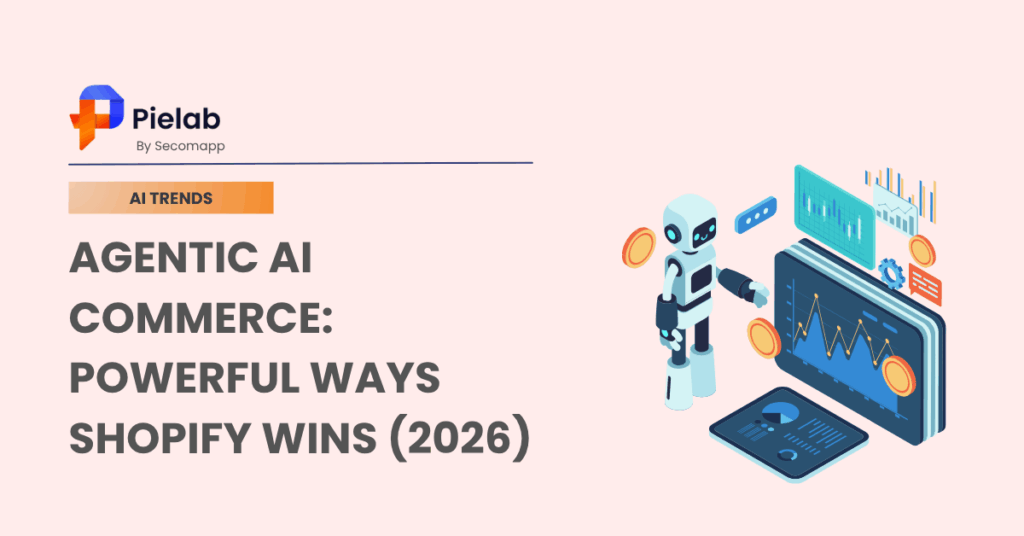
AI agents are now buying products on behalf of shoppers, and most Shopify stores are invisible to them. That is the core problem agentic commerce creates – and the opportunity it hides.
Agentic commerce is a model where AI software researches, compares, and purchases products with minimal human input. If your store is not structured for machine readability, agents skip you entirely, regardless of how good your products are. McKinsey estimates this market could reach between $3 trillion and $5 trillion by 2030. The merchants who prepare now will capture a disproportionate share.
Here is what you need to know, and what to do about it.
Summary
What Is Agentic Commerce and Why Shopify Merchants Cannot Ignore It
What is agentic commerce, exactly? It is not a chatbot. It is not a product recommendation widget. Agentic commerce means an AI system independently handles the entire shopping journey: searching, comparing, deciding, and completing checkout, often without the shopper clicking a single button.
Think about it this way. A chatbot that suggests a moisturizer based on skin type is conversational ai commerce. An AI that queries five skincare brands, compares ingredient lists and return policies, then buys the best match under $40 is agentic commerce.
This distinction matters because the rules are completely different. As AI trends in e-commerce evolve, the focus is shifting from simple assistance to full autonomy.
Platforms like Microsoft Copilot Checkout and Perplexity Instant Buy already let shoppers purchase without ever visiting a product page. Google’s AI Mode checkout is expanding. ChatGPT surfaces products and sends buyers directly to brand checkout. If your product data cannot be read by these systems, you do not exist in their results. It is not a ranking problem. It is a visibility problem.
The result: Shopify reported AI-driven orders increased 15-fold in 2025. Brands like Keen Footwear and Pura Vida are already generating sales through Microsoft Copilot. The window to prepare is now, not next quarter.
Which Pages Lose Visibility in Agentic Commerce First
Not every page on your store is equally exposed. Understanding where agents struggle tells you where to focus first.
High-risk pages:
- Product pages with vague titles (“Adventure Pack, Green” instead of “40L Waterproof Hiking Backpack with Laptop Compartment”)
- Pages where key specs are buried in design templates or loaded via JavaScript
- Variants presented as separate products instead of grouped under one parent listing
- Policy pages hidden inside accordion menus or linked from footers only
Lower-risk pages:
- Brand pages with clear, factual copy and structured FAQ sections
- Products already listed in Google Merchant Center with complete attributes
- Pages with schema markup showing price, availability, and product type
The pattern across stores that struggle with agentic commerce visibility is always the same: good products, structured badly. Fixing the structure does not require rewriting your entire catalog. It requires making the right information machine-readable.
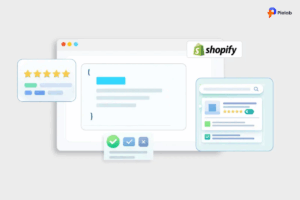
Fix 1: Audit Your Structured Product Data (Do This First)
Why this matters: AI agents do not browse your store the way humans do. They read structured fields. If your product title is vague or your size options are embedded in an image, an agent cannot surface your product in a query like “waterproof backpack under $80 with laptop compartment.”
Before / After:
Steps:
- Open your Shopify Admin and go to Products. Review your top 20 by revenue or traffic first.
- For each product, check: Does the title include material, size, and primary use case? Are variants grouped correctly (not listed as separate products)?
- Go to Google’s Rich Results Test (search.google.com/test/rich-results) and paste each URL. If Price and Availability do not appear in the output, your schema is incomplete.
- Submit your product catalog to Google Merchant Center. This feeds your inventory directly into Google’s ai commerce tools.
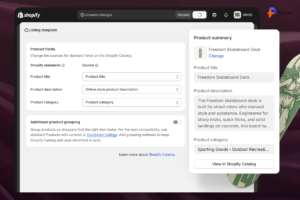
- If you are on Shopify, use Shopify Catalog Mapping to customize how your product data is broadcast to AI platforms.
Time to complete: 20 to 30 minutes per product page. Start with your top 20. Who should do this first: Any store with 30 or more products that has not audited product titles or schema in the past 6 months. Skip for now if: You have under 10 SKUs and recently rewrote all product descriptions with specific specs.
Fix 2: Build an AI-Facing Store Presence
Why this matters: Agentic commerce agents do not just read product fields. They also pull from your return policy, shipping page, FAQ section, and customer reviews to decide whether your store is trustworthy. If a shopper instructs their agent to “only buy from stores with free returns,” and your returns policy is buried in a footer accordion, the agent cannot verify it — and moves on.
Steps:
- Create or update a dedicated Returns Policy page with a clear heading (“Free Returns Within 30 Days”). Use plain HTML text, not accordion menus or JavaScript-rendered content.
- Add a Shipping Information page that states delivery timeframes and regions clearly.
- Place FAQ sections directly on product pages — not only on a separate FAQ page. AI agents read page-level content when evaluating individual products.
- Enable or import customer reviews onto product pages. Agents assess quality signals from review data.
- If you are on Shopify, use the Knowledge Base tool to review and customize the information AI platforms use about your store. This lets you train agents on your brand policies before a shopper’s agent makes a decision.
Time to complete: 2 to 4 hours across the full store. Policy pages take under an hour. Adding FAQs to product pages is the bigger time investment.
Worth it if: You sell in a competitive category where price, shipping speed, and return policy are common decision factors.
Skip for now if: You already have policy pages with clear headings and product-level FAQ sections.
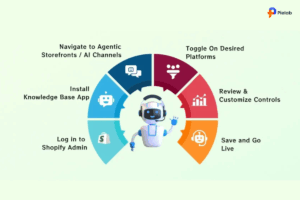
Fix 3: Enable Agentic Storefronts and Monitor AI Channel Performance
Why this matters: Shopify’s Agentic Storefronts package your product catalog, checkout, and brand information so AI platforms can present them natively inside a conversation. As of March 2026, this is available to millions of Shopify users. If you are eligible and selling to US shoppers, your products are automatically discoverable in ChatGPT. For Copilot and Google, you need to turn it on manually.
Steps:
- Check your Shopify Admin dashboard for an eligibility notification for Agentic Storefronts.
- Go to Settings, then Sales Channels. Enable direct checkout for Copilot and Google AI Mode.
- Verify your products are in Shopify Catalog, which automatically broadcasts data across connected AI platforms.
- Once live, search for your products in ChatGPT, Perplexity, Gemini, and Copilot the way a customer would. Ask: “What is the best [your product category] under [price point]?” Check that your store appears and that the information is accurate.
- Monitor agentic storefront orders in Shopify Admin. Each order shows channel attribution so you can see which AI platform drove the sale.
Time to complete: 30 minutes to enable. Ongoing monitoring takes 15 minutes per week.
Who should prioritize this: Stores already selling to US customers with a complete product catalog.
Skip for now if: Your product data and policy pages are not yet updated. Agentic storefronts broadcast whatever data exists – garbage data in means poor results out.
How to Track Whether Your Agentic Commerce Fixes Are Working
Timeline: Schema fixes show up in crawl data within 2 to 3 weeks. AI agent visibility improvements take 8 to 12 weeks before trends become clear in Search Console. Do not draw conclusions at the 4-week mark.
What not to do: Do not watch for overnight spikes. Agentic commerce visibility compounds over time, the same way organic SEO does. The stores that fix their structure in Q2 will be the ones capturing AI-driven orders by Q4.
What to Do Right Now
Agentic commerce is not a future trend. It is the current state of how a growing share of buyers, especially in the 18 to 35 demographic, are shopping. AI agents are already making purchase decisions. The question is whether they can find and trust your store.
The three fixes in this guide take less than one full workday to complete across a catalog of 50 products. Start with your top 20. Fix the titles, fill in the schema, clean up your policies, and turn on the channels.
Stores that take this seriously now will not have to play catch-up later.
Ready to make your Shopify store fully visible to AI agents?
SearchPie’s Optimize for AI feature audits your product data, identifies schema gaps, and helps you structure content so AI platforms can find and trust your store. It is built specifically for Shopify merchants who want to compete in agentic and AI commerce without needing a developer. Try AI workflow builder now and see exactly where your store stands today.
FAQs
Agentic commerce is a digital shopping model where AI autonomously researches, compares, and buys products for consumers with minimal human involvement. This automated process is supported by open standards like the Universal Commerce Protocol (UCP), which allows AI to smoothly transact with merchants.
Agentic AI is a broad concept for systems that independently plan and execute tasks across various industries. In contrast, agentic commerce is the specific application of this autonomy to the retail journey, handling everything from product discovery to checkout.
The term “agentic” refers to an AI’s ability to make decisions and act independently without needing step-by-step human instructions. In e-commerce, this means the AI can autonomously navigate the entire shopping and checkout process on your behalf.
The main types include consumer-facing shopping assistants (like ChatGPT), internal business agents that automate retail operations, and emerging agent-to-agent models. In the agent-to-agent model, a buyer’s AI and a retailer’s AI could directly communicate and negotiate transactions without human intervention.
A Shopify agentic plan is a strategy that uses AI agents to automate and optimize store operations, marketing, and customer interactions. It helps Shopify merchants scale faster by reducing manual work and improving decision-making.