
Starting a clothing brand on Shopify is one thing. Building a store that actually converts visitors into buyers is something else entirely. The gap between the two usually comes down to a handful of decisions: how the store looks, how it communicates value, how fast it loads, and how easy it is to navigate.
The best way to learn what works is to study Shopify clothing stores that are already doing it well. This guide breaks down 10 real Shopify store examples from the fashion and apparel space, what each one gets right, and the specific lessons you can apply to your own store today.
Summary
- Section 1: What separates great Shopify clothing stores from average ones
- Section 2: 10 Shopify clothing store examples and what makes each one work
- Section 3: Key lessons from the best Shopify websites in fashion
- Section 4: How SearchPie helps your Shopify clothing store get found and convert
What Makes Great Shopify Clothing Stores Stand Out
Before looking at specific Shopify store examples, it helps to understand the common traits that separate high-performing Shopify clothing stores from those that struggle to convert.
Every Shopify clothing store example in this guide demonstrates at least several of these traits. As you read through them, think about which lessons apply most directly to your own store’s current weaknesses.
10 Shopify Clothing Store Examples Worth Studying
1. Gymshark
Gymshark is one of the most well-known Shopify websites in the fitness apparel space and a strong example of how community-driven marketing can scale a clothing brand from a small operation to a global name. The store’s product pages are clean and fast, leading with large lifestyle images that show the clothing being worn during actual workouts.
What Gymshark does well:
The navigation is minimal. Shoppers reach product categories in two clicks from the homepage. Size guides appear prominently on every product page, which directly reduces hesitation and returns. Social proof is embedded throughout, with user-generated content pulled from a highly engaged community of athletes and fitness creators.
Lesson for your Shopify clothing store: Clear navigation and strong size guidance are not optional extras. They are conversion rate fundamentals that every Shopify clothing store should implement before focusing on anything else.
2. Allbirds
Shopify clothing stores example showing Allbirds product page with sustainability messaging and material detail photography
Allbirds is one of the most cited Shopify store examples in the sustainable fashion space. What makes the Allbirds store distinctive is how it uses the product page itself to tell the brand’s environmental story, with specific material details, carbon footprint numbers, and certifications placed near the product description.
What Allbirds does well:
The store turns product features into a values statement. Instead of listing “merino wool upper” as a dry specification, Allbirds explains why that material choice matters and what it means for the planet. This approach builds the kind of trust that converts first-time visitors into buyers.
Lesson for your Shopify clothing store: If your brand has a strong value or mission behind it, use your product pages to tell that story clearly. Shoppers who connect with your values before they buy are far more likely to become repeat customers.
3. Chubbies
Chubbies built a massively loyal following by committing fully to a single personality: loud, fun, and unapologetically celebratory of weekend culture. Every element of the Shopify website, from the product names to the copy on the Add to Cart button, reflects this personality consistently.
What Chubbies does well:
The product descriptions are entertaining without being vague. They describe the fit, material, and occasion in language that matches the brand voice perfectly. The homepage is updated seasonally and always communicates a single, clear promotional message rather than trying to show everything at once.
Lesson for your Shopify clothing store: A strong, consistent brand voice is a competitive advantage. Shopify clothing stores that sound like every other fashion brand blend into the background. Chubbies proves that committing to a distinctive voice builds loyalty faster than playing it safe.
4. Reformation
Reformation is one of the most widely admired Shopify store examples in the sustainable women’s fashion space. The store is visually minimal with a heavy focus on editorial-style photography that makes each product feel aspirational rather than transactional.
What Reformation does well:
Every product page includes a sustainability score showing the environmental impact of producing that specific item. This transparency builds significant trust with an audience that actively cares about the ethics of their purchases. The photography uses consistent lighting and composition across all products, which creates a professional visual cohesion that many smaller Shopify clothing stores lack.
Lesson for your Shopify clothing store: Consistency in photography style across your entire catalog makes a small brand look significantly more established and trustworthy. Invest in a consistent visual approach before scaling your product range.
5. Taylor Stitch
Taylor Stitch is one of the most innovative Shopify store examples in terms of business model. Their “Workshop” pre-order system allows shoppers to reserve items before they go into production, with a funding progress bar shown directly on the product page. Items that reach their funding goal go into production. Items that do not are cancelled.
What Taylor Stitch does well:
The pre-order model creates genuine scarcity and urgency without resorting to fake countdown timers. Shoppers who see a product at 85% funded feel real motivation to pre-order before the production window closes. The store also communicates the sustainability benefit of this model clearly, reducing overproduction and waste.
Lesson for your Shopify clothing store: Urgency is most powerful when it is tied to a real business reason. Taylor Stitch shows that transparency about your production process can itself become a conversion tool.
6. Princess Polly
Princess Polly is one of the fastest-growing Shopify clothing stores in the women’s fashion space, particularly among a younger demographic. The store moves quickly with new product drops and uses a strong social media presence to drive traffic back to the Shopify website.
What Princess Polly does well:
The store uses a very clean, white layout that puts the clothing front and center. New arrivals are featured prominently on the homepage and updated frequently, giving repeat visitors a reason to return often. The mobile experience is particularly strong, with large tappable product images and a sticky Add to Cart button that remains visible as shoppers scroll through product details.
Lesson for your Shopify clothing store: Frequent new arrivals and a clean, fast mobile experience are two of the highest-impact investments for fashion-focused Shopify clothing stores targeting younger shoppers.
7. Bombas
Bombas sells socks and apparel with a buy-one-donate-one social mission, and the Shopify website communicates this mission as clearly as it communicates the products themselves. The donation counter showing how many items have been donated appears on the homepage and is updated in real time.
What Bombas does well:
The mission-driven messaging is not buried in an About page. It is part of the main conversion copy on the homepage and product pages. Shoppers who buy from Bombas are not just purchasing socks. They are participating in a social impact mission, which significantly increases perceived value and willingness to pay a premium price.
Lesson for your Shopify clothing store: If your brand donates, partners with charities, or has a social mission, make that visible throughout the shopping journey, not just on a dedicated mission page.
8. Boohoo
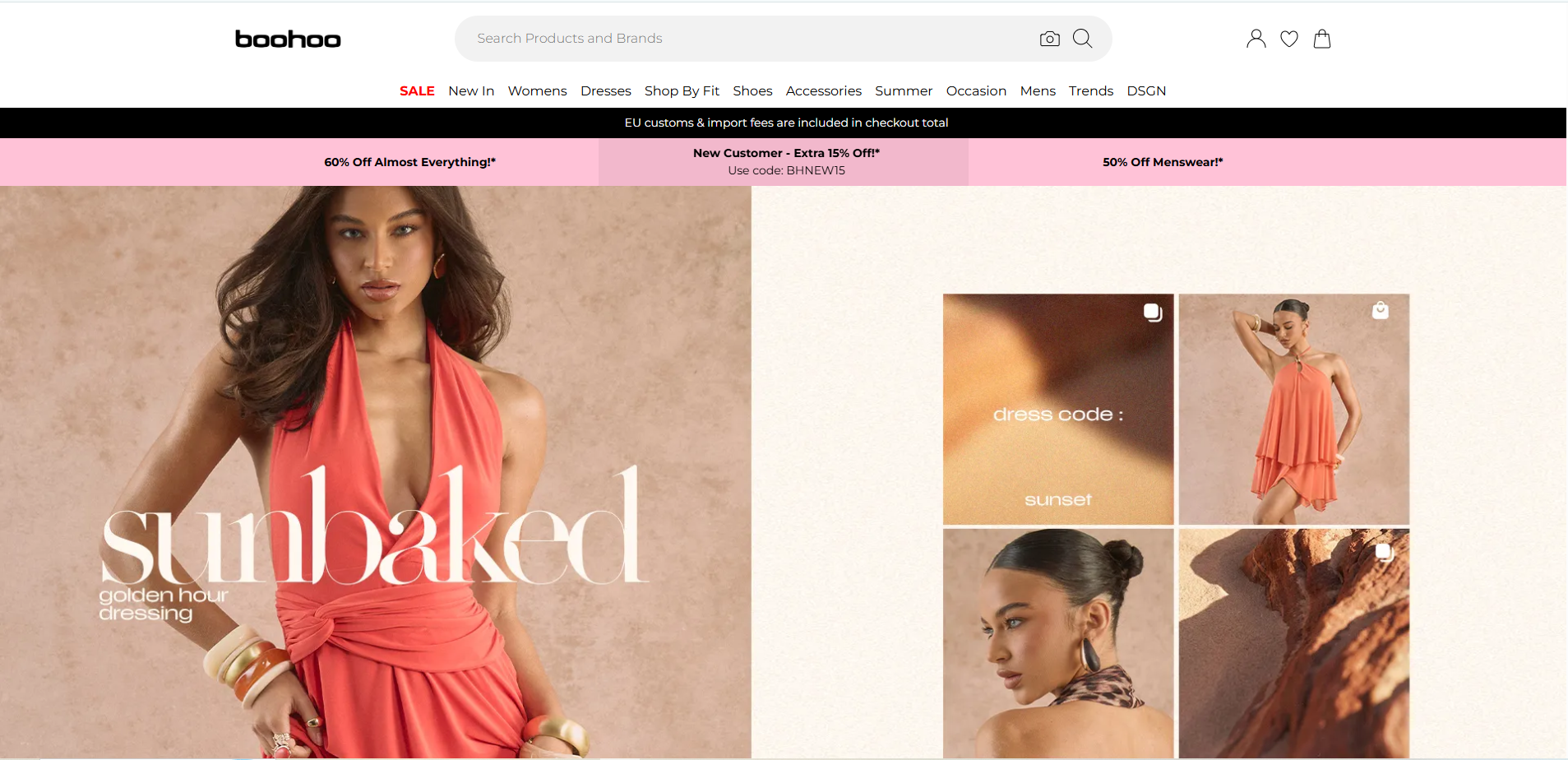
Boohoo operates at the opposite end of the fashion spectrum from many brands in this list. It is a high-volume, fast fashion Shopify clothing store that wins on price, speed of new product launches, and promotional urgency.
What Boohoo does well:
The store communicates its value proposition instantly. Discounts, new arrivals, and promotional events are visible within the first second of landing on any page. The navigation is organized by occasion and trend rather than by basic category, which helps shoppers find what they are looking for based on intent rather than product type.
Lesson for your Shopify clothing store: If price and promotion are central to your value proposition, make that immediately visible rather than making shoppers hunt for it. Promotional banners and new arrival highlights should be the first thing shoppers see.
9. Patagonia
Patagonia is one of the most respected Shopify store examples in the outdoor and activewear space, known globally for its environmental activism and commitment to product durability. The Shopify website reflects these values at every level of the shopping experience.
What Patagonia does well:
The product pages include detailed information about materials, ethical sourcing, and repairability. The store actively encourages shoppers to consider buying used Patagonia items through an integrated worn-wear section, which is a remarkable example of brand confidence. This counterintuitive approach builds enormous trust and loyalty.
Lesson for your Shopify clothing store: Transparency and confidence in your product quality are more persuasive than promotional discounts for a significant segment of shoppers. Brands that show they stand behind their products long-term attract customers with significantly higher lifetime value.
Key Lessons From the Best Shopify Websites in Fashion
Across all 10 of these Shopify clothing store examples, several patterns emerge consistently.
No single Shopify clothing store does all of these perfectly. But the most successful Shopify websites in fashion consistently do more of them than their competitors.
How SearchPie Helps Your Shopify Clothing Store Get Found and Convert
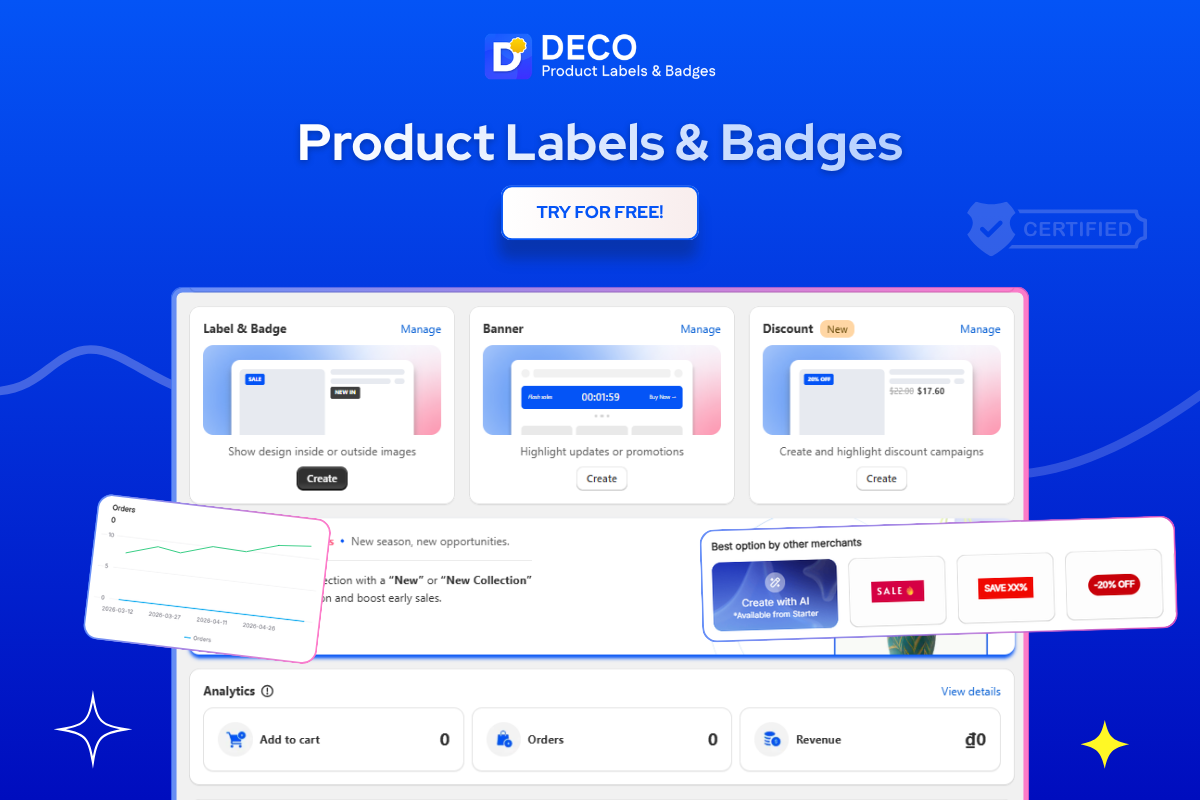
Most of the conversion rate advantages visible across the best Shopify clothing store examples in this guide come down to two things: making shoppers feel confident about their purchase and giving them a reason to act now rather than later. DECO addresses both directly.
Sale and promotion labels. DECO lets you add visible sale badges, percentage-off labels, and custom promotional text directly onto product images on collection and product pages. When a shopper is browsing a clothing collection and sees a clear “20% Off” badge on specific items, they click through at a higher rate than on unlabeled products. This is one of the simplest conversion rate improvements available for any Shopify clothing store running promotions.
Countdown Timer labels. DECO’s Countdown Timer labels display live timers on product pages linked to your actual promotion schedule. For Shopify clothing stores running flash sales, end-of-season clearances, or limited-time offers, a visible countdown creates the kind of urgency that the best Shopify store examples in this list use to drive faster purchase decisions.
Low Stock and Selling Fast labels. DECO connects stock labels to your real inventory data. A “Low Stock” or “Only 3 Left” label that reflects accurate availability is a credible urgency signal that shoppers respond to. For fashion brands where certain sizes sell out quickly, showing accurate stock levels on collection pages helps shoppers prioritize their decision before their size disappears.
Payment Trust Badges. DECO lets you place payment icons including Visa, Mastercard, PayPal, Apple Pay, and regional options like Tamara, Mada, and GCash directly below the Add to Cart button. For Shopify clothing stores targeting international markets or specific regional audiences, showing locally recognized payment methods at the point of purchase removes the hesitation that comes from unfamiliar checkout options.
Mobile-optimized label sizing. DECO allows separate size configurations for mobile and desktop label display. This means urgency labels and sale badges on your Shopify clothing store never accidentally cover the Add to Cart button on smaller screens, a technical detail that directly protects your mobile conversion rate.
Banner Bars for site-wide promotions. DECO’s Banner Bars keep your current offer visible across every page of your Shopify website, from the homepage through to the product page and cart. A shopper who browses multiple clothing items before deciding is reminded of the promotion consistently, which keeps the offer front of mind throughout the decision-making process.
Best for: Shopify clothing stores that want to improve conversion rate through on-page urgency signals, trust badges, and promotional labels without requiring any code changes or additional development work.
FAQS
Successful Shopify clothing stores combine strong branding, high-quality product photography, fast page speed, mobile-friendly design, and a simple checkout experience.
Yes. Shopify provides everything you need to launch an online clothing store, including customizable themes, secure payments, inventory management, and marketing integrations.
Every Shopify clothing store should have clear product descriptions, size guides, customer reviews, multiple product images, and easy-to-find shipping and return policies.
They attract customers through SEO, social media marketing, email campaigns, influencer partnerships, and optimized product pages that rank well in search engines.
Studying successful Shopify clothing stores can help you improve your store’s design, navigation, branding, product presentation, and conversion strategy by applying proven ecommerce best practices.