
Your customers are not just searching Google anymore. They are asking ChatGPT which products to buy. They are using Perplexity to compare options. They are asking Gemini for recommendations before they ever visit a store.
If your Shopify store does not show up in those AI-generated answers, you are invisible to a growing share of ready-to-buy shoppers, and most of your competitors have not figured this out yet.
This guide explains what LLMO is,how it connects to broader trends like answer engine optimazation (AEO), why it matters for Shopify merchants specifically, and 10 strategies you can start using right now to get your brand mentioned, cited, and recommended by AI tools.
Summary
Section 1: What LLMO Actually Is: First, LLMO (Large Language Model Optimization) is the practice of optimizing your brand to appear in AI-generated answers on platforms like ChatGPT, Perplexity, and Gemini, rather than just traditional Google search results.
Section 2: Why LLMO Matters for Shopify Stores Right Now: Next, as buyer search habits shift toward AI chatbots for purchase decisions, early adoption offers a massive competitive advantage for Shopify merchants over competitors who wait.
Section 3: How LLMO and Traditional SEO Work Together: Furthermore, LLMO does not replace traditional SEO; instead, it builds upon it. Stores with a strong organic SEO foundation are already one step ahead in AI visibility.
Section 4: 10 Proven LLMO Strategies for Shopify Merchants: Subsequently, merchants can apply 10 actionable strategies to boost AI presence, including rewriting product descriptions, building strong entity associations, and earning credible citations.
Section 5: How to Track Your LLMO Progress and What to Do Next: Finally, it is crucial to measure your campaign’s success. Shopify merchants can easily handle the technical side of this without a developer by using SearchPie’s Optimize for AI feature.
Quick Facts: LLMO for Shopify Merchants
What Is LLMO? A Simple Definition
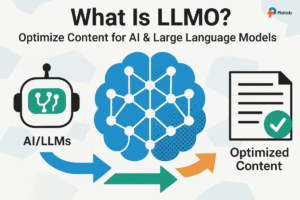
LLMO stands for large language model optimization. It is the practice of making your brand, your content, and the information around your store more likely to appear in AI-generated answers.
When someone asks ChatGPT “what is the best reusable water bottle for hiking,” the AI does not pull up a list of ranked pages. It generates an answer based on content it has been trained on or retrieved from the web. The brands that show up in that answer have content that AI can find, read, and trust.
That is what LLMO large language model optimization is about: giving AI tools enough clear, credible, structured information about your brand that they include you when it matters.
LLMO SEO is different from traditional SEO in one key way. Traditional SEO earns you a ranking on a results page. LLMO earns you a mention inside an AI-generated answer. Both matter. Neither replaces the other.

Why Shopify Merchants Need LLMO Right Now
Gartner predicts that 50% of traditional search engine traffic will disappear by 2028 as AI tools take over the research and discovery phase of shopping. That is not a distant problem. It is already showing up in traffic data for merchants who rely on informational and comparison queries.
AI chatbots are not just answering questions. They are recommending products. They are telling shoppers which brands to trust. They are functioning like a knowledgeable friend who happens to know everything about your product category.
If your store is not in that conversation, another brand is.
The good news for Shopify merchants is that most stores have not started LLMO yet. Unlike Google SEO, where competition for top positions is intense, AI citation is still wide open for many product categories. The merchants who build strong AI visibility now will have an advantage that compounds over time.
How LLMO and Traditional SEO Work Together
Before getting into strategies, one thing is worth being clear about: LLMO SEO does not replace your existing SEO work. It builds on top of it.
Research from Seer Interactive found a strong correlation between organic search rankings and brand mentions in AI-generated answers. Brands that rank well in Google are significantly more likely to appear in AI responses. Your existing SEO foundation is already feeding your LLMO visibility.
The difference now is that your content also has to work for AI models, not just Google’s crawlers. That means being specific, being credible, and being structured in a way AI can extract and use.
10 LLMO Strategies for Shopify Merchants
1. Make Your Product Content Specific and Factual
Vague content does not get cited by AI. “Premium quality, great for gifting” tells a language model nothing it can use. “This 20oz stainless steel mug keeps drinks hot for 8 hours, fits standard car cup holders, is BPA-free, and is dishwasher safe” gives an AI model specific facts it can pull into an answer.
Go through your top 20 product pages. Replace every generic phrase with a concrete detail. Dimensions, materials, compatibility, use cases, honest limitations. This is the fastest LLMO fix available and it also improves your conversion rate.
Worth knowing: AI models used for LLMO large language model optimization pull from content that is clear, factual, and easy to extract. The more specific your product content, the more usable it is.
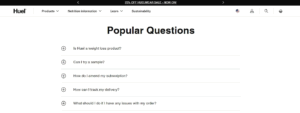
2. Add FAQ Sections to Every Key Page
FAQ content is structured the way AI thinks. A question followed by a clear, direct answer is exactly what language models look for when generating responses to question-based queries.
Add 3 to 5 real buyer questions to each important product page. “Does this come in different sizes?” “What material is this made from?” “How long does shipping take?” Write answers in one or two sentences. You can add FAQ sections directly in the Shopify page editor without any code.
This also helps with Google SGE (AI Overviews), which pulls FAQ content directly for featured placements.
3. Add Structured Data So AI Can Read Your Pages
Structured data (schema markup) tells AI systems explicitly what is on your page: product name, price, availability, reviews, FAQs. Without it, AI has to guess. With it, AI can extract and use your information accurately.
Most Shopify themes include basic product schema automatically. What is almost always missing is review schema and FAQ schema — and those are the types AI citation relies on most. Go to Google’s Rich Results Test, paste your product page URL, and check what schema is currently detected.
If review schema or FAQ schema is not showing up, that is a gap worth fixing. A Shopify SEO app can add these without you touching theme code.
4. Build E-E-A-T Signals Into Your Store
E-E-A-T stands for Experience, Expertise, Authoritativeness, and Trustworthiness. It is how Google evaluates content quality, and it is also what AI models use to judge whether a source is worth citing.
For a Shopify store, E-E-A-T shows up in practical ways:
A product page with two generic sentences and no reviews sends the opposite signal. AI tools will not cite a source they cannot verify as credible.
5. Get Your Brand Mentioned on Other Websites
AI models build associations between brands and topics by analyzing how your brand is discussed across the web. If your brand name appears alongside “sustainable yoga gear” on five credible sites, AI starts to associate your brand with that topic.
This is why PR matters for LLMO SEO. Reach out to bloggers, newsletter writers, and review sites in your niche. Offer a product sample in exchange for an honest review with a mention and link. Look for roundup articles in your product category and suggest your brand for inclusion.
One quality mention on a relevant, credible site is worth more than ten directory links. Focus on relevance and credibility over volume.
6. Use Quotes and Real Data in Your Content
Research testing 10,000 queries across AI-powered search tools found that content with quotes, statistics, and citations saw 30 to 40% higher visibility in AI-generated answers compared to unoptimized pages.
If you have a blog on your Shopify store, include real data: customer results, product test outcomes, third-party statistics relevant to your niche. If you run a skincare brand, cite a dermatology study. If you sell fitness equipment, reference workout performance data.
These additions also attract backlinks, which feeds back into your traditional SEO and your LLMO visibility at the same time.
7. Create Content That Covers Topics Deeply
AI models favor content that thoroughly covers a subject rather than skimming the surface across many topics. A single, well-structured buying guide that covers everything a shopper needs to know about choosing a yoga mat will get cited more often than five thin blog posts on loosely related topics.
For Shopify merchants, this means writing a few strong buying guides and comparison articles that link naturally to your product pages. These pieces target informational searches, build topical authority, and give AI models something comprehensive to pull from.
Reality check: You do not need a massive blog. Two or three well-written, genuinely useful guides per product category will outperform ten rushed posts every time.
8. Keep Your Content Fresh and Updated
RAG-based AI tools (like Perplexity and Google AI Overviews) pull live content from the web when generating answers. Outdated content gets deprioritized in favor of current information.
Go back to your most important product pages and blog posts every 3 to 6 months. Update any outdated details, refresh pricing if it has changed, and add new information where relevant. Add a “Last updated” date to blog posts to signal freshness.
This is especially important for seasonal products, pricing-sensitive categories, and anything where specifications change.
9. Fix Duplicate Content Issues
Shopify creates multiple URLs for the same product when it appears in different collections. Without canonical tags in place, AI crawlers may index multiple versions of your page and treat them as separate, thinner pieces of content rather than one authoritative source.
In Google Search Console, open the Pages report under Indexing and check for “Duplicate, submitted URL not selected as canonical” warnings. If you have several, fix them. A Shopify SEO app can manage canonical tags automatically across your entire store.
10. Make Sure AI Crawlers Can Access Your Pages
Some websites block AI crawlers through their robots.txt settings or security tools. If AI systems cannot crawl your pages, they cannot cite them. This is a simple thing to check and easy to miss.
Ask a developer or use a crawl testing tool to verify that common AI crawlers (GPTBot for OpenAI, Googlebot for Google AI Overviews, PerplexityBot for Perplexity) are not blocked. If they are, that is the first thing to fix before any other LLMO work.
How to Track Whether Your LLMO Efforts Are Working
LLMO progress is harder to measure than traditional SEO because Google Search Console does not break out AI citation traffic separately. However, there are practical ways to track movement.
Give any LLMO change 8 to 16 weeks before evaluating results. AI training cycles and retrieval patterns are slower to reflect changes than standard Google indexing.
Ready to Optimize Your Shopify Store for AI Search?
Understanding LLMO is one thing. Actually fixing schema across hundreds of product pages, managing canonical tags, and auditing your store for AI readability is where most merchants get stuck.
SearchPie’s Optimize for AI feature handles the technical side for you. It audits your structured data, identifies pages missing schema, flags duplicate content issues, and pushes fixes across your store without any code changes needed.
If LLMO SEO has been on your list but the technical work keeps getting in the way, SearchPie is the shortcut. Your first AI readiness audit takes under 5 minutes.
Install SearchPie on the Shopify App Store and find out exactly which pages AI tools cannot read yet.