

According to Gartner’s predictions, traditional search engine traffic could decline by up to 25% by 2026 as AI assistants increasingly replace informational queries. This signals a major shift: instead of browsing “10 blue links,” users now receive AI-generated summaries. In this new landscape, ranking alone is not enough. AI systems surface content based on credibility, structure, and trust. This guide explains what E-E-A-T means, how it connects to Google’s Search Quality Rater Guidelines, and why it shapes modern search evaluation.
Summary:
- Section 1: You’ll gain a clear understanding of what E-E-A-T means according to Google and why it matters more in AI search environments, where credibility and trust determine whether your content is selected or cited.
- Section 2: You’ll see how E-E-A-T connects to Google’s Search Quality Rater Guidelines, and how these principles shape the systems that evaluate content quality, especially for AI-generated answers.
- Section 3: You’ll see how E-E-A-T differs from traditional SEO by moving beyond keyword density and ranking tactics toward credibility, entity clarity, and trust-centered content evaluation.
What Is E-E-A-T and Why Does It Matter for AI Search?
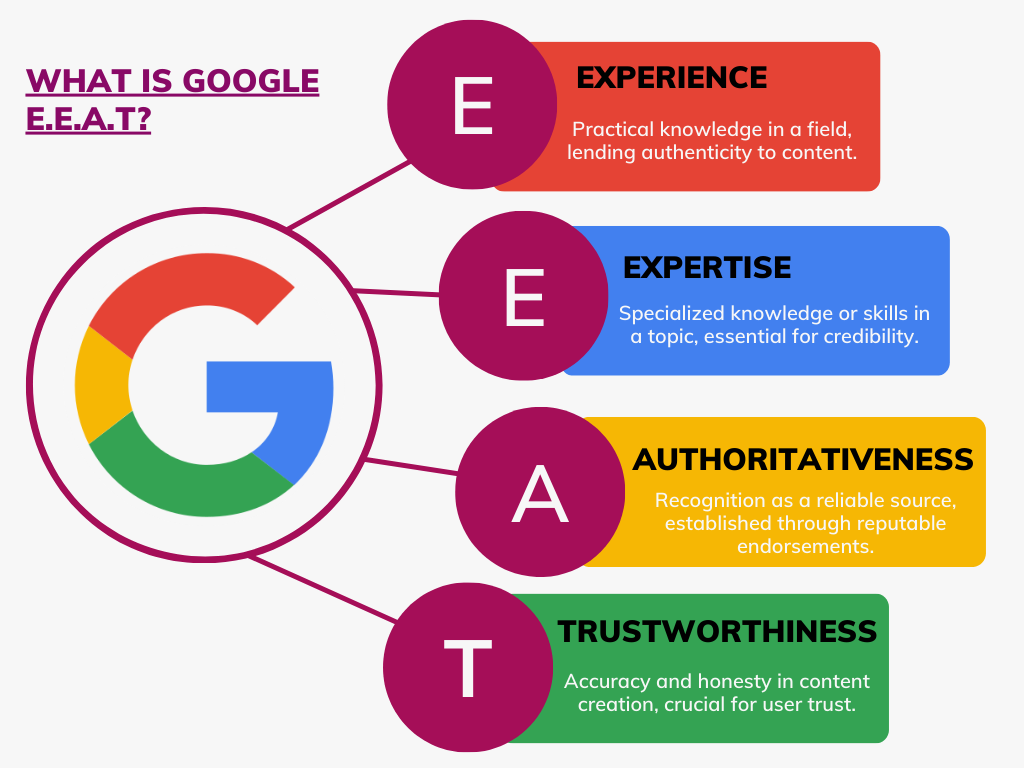
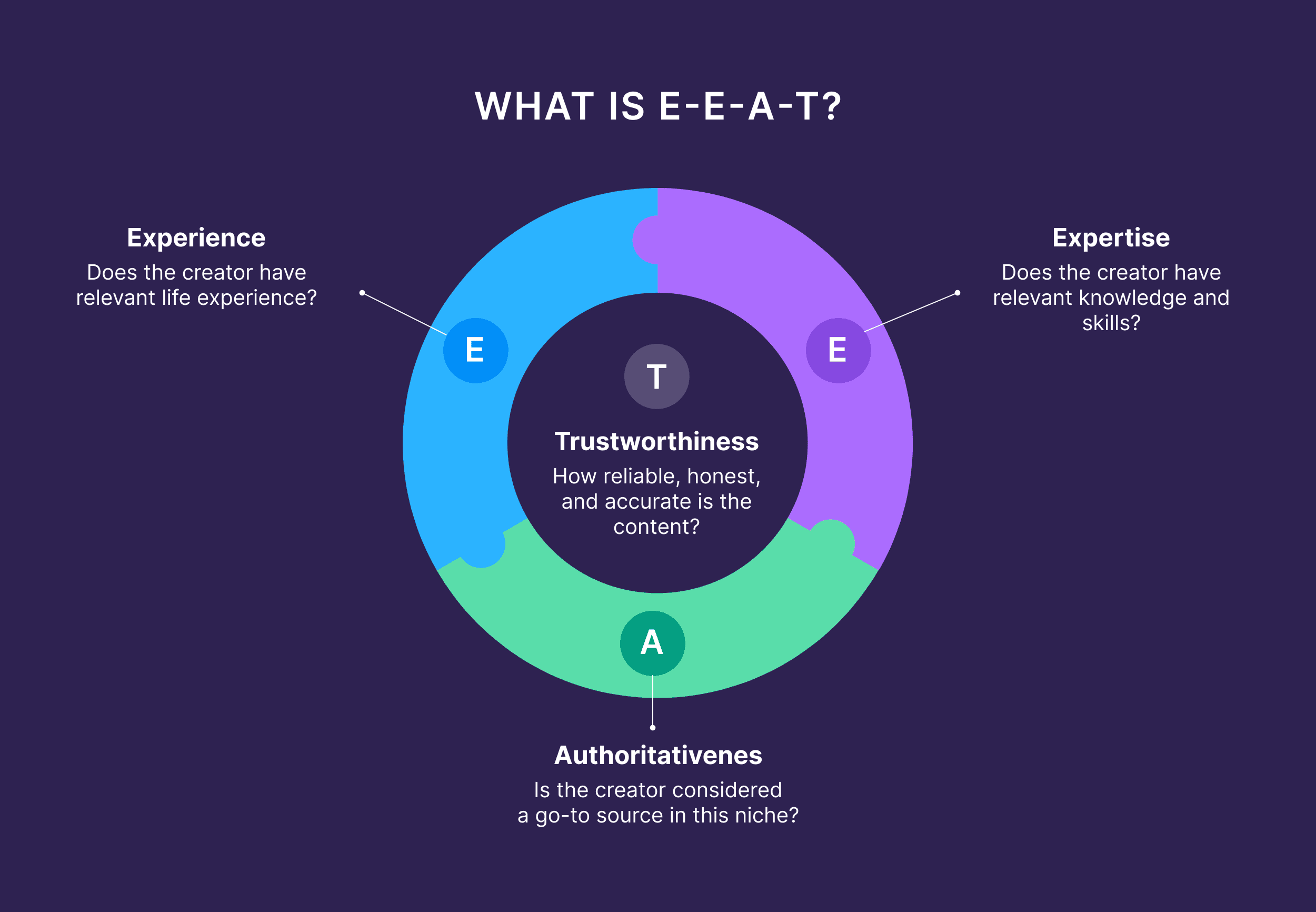
E-E-A-T stands for Experience, Expertise, Authoritativeness, and Trust, a concept defined in Google’s Search Quality Rater Guidelines as a framework for evaluating the overall quality and credibility of content. Google clarifies that E-E-A-T is not a single ranking factor, but a set of principles used to assess whether content is helpful, reliable, and created with users in mind.
In AI search environments, these principles matter even more. As Google explains in its guidance on helpful, people-first content, systems are designed to reward content that demonstrates genuine value, expertise, and trustworthiness rather than content created primarily to manipulate rankings.
Each component has a specific meaning according to Google:
1. E – Experience
This refers to the extent to which the content creator has direct, first-hand involvement with the topic. Google highlights that content should demonstrate real-world use or lived experience when appropriate. For example, a product review is more credible when it reflects actual testing, screenshots, or personal insight rather than a rewritten product description. First-hand experience helps signal authenticity and reduces the likelihood of superficial or generic content.
2. E – Expertise
It relates to the depth of knowledge or skill demonstrated in the content. The level of expertise required depends on the topic. For everyday subjects, practical knowledge may be sufficient. However, for YMYL (Your Money or Your Life) topics such as health, finance, or legal advice, a much higher standard of subject-matter expertise. Clear, accurate explanations and technically sound information contribute to this signal.
3. A – Authoritativeness
This focuses on reputation and recognition. It reflects how the creator, website, or brand is perceived within its niche. Authority is often reinforced by external validation, such as credible backlinks, industry mentions, references, citations, or a strong brand presence. In essence, it answers the question: Is this source recognized by others as a reliable voice on the topic?
4. T – Trust
It is considered by Google to be the most important element of E-E-A-T. Without trust, the other components lose value. Trust involves accuracy, transparency, and reliability. Content should be factually correct, up to date, clearly authored, and supported by verifiable information where necessary. Technical factors also play a role, including secure browsing (HTTPS), transparent policies, and accessible contact information. Trust ensures that users — and search systems — can rely on the content with confidence.
AI systems are designed to reduce misinformation and hallucination risks. While E-E-A-T is not a direct ranking factor, its principles align closely with how modern search systems evaluate content quality and trustworthiness. Without these foundations, content may still be indexed but it is less likely to be selected, synthesized, or cited in AI-generated responses.
How Does It Change Traditional SEO Signals?
After understanding how E-E-A-T is defined and how it connects to Google’s Search Quality Rater Guidelines, the next question becomes practical: how does this framework actually change the way SEO works in an AI-driven environment?
The answer lies in a fundamental shift in evaluation criteria. Traditional SEO focused on optimizing pages to rank within search results. AI-powered results appear to prioritize sources that demonstrate strong credibility, structure, and entity clarity. This means the goal is no longer just visibility in a list of links, but eligibility to be summarized, cited, or referenced by AI systems.
As a result, optimization moves from ranking mechanics to credibility signals, from “How do I rank higher?” to “Why should AI trust this content enough to use it?”. This shift reframes traditional SEO. Keywords and links still matter, but they now support a larger objective: building structured, credible, and authoritative signals that AI systems can confidently rely on.
How Does E-E-A-T Connect to Google’s Search Quality Rater Guidelines?
E-E-A-T connects directly to Google’s Search Quality Rater Guidelines, which outline how content quality should be assessed from a human perspective. Although human quality raters do not directly influence rankings, their evaluations are used to test and refine Google’s ranking systems. In other words, the guidelines help train the algorithms that determine what content deserves visibility.
Within the guidelines, Google emphasizes that high-quality content should demonstrate strong E-E-A-T, especially for topics that impact a person’s health, finances, or safety. Google states in its Search Quality Rater Guidelines that Trust is the most important element of E-E-A-T.
The core principles include:
- People-first content: Content should be created to genuinely help users, not primarily to manipulate search rankings.
- Accurate and reliable information: Claims should be supported by evidence, expertise, or credible references.
- Clear authorship and accountability: Users should understand who is responsible for the content.
- Transparent sourcing: Information should be traceable, verifiable, and consistent.
AI search systems follow the same trust logic. Because AI models generate synthesized answers rather than simply ranking links, they must rely on sources that demonstrate credibility and structural clarity. Structured data, logical content hierarchy, consistent entity signals, and accurate metadata all reinforce these quality standards.
For this reason, technical structure and authority signals are no longer optional optimizations. They are foundational elements that support how AI systems evaluate trust and decide which sources are safe to summarize or cite.
Conclusion
E-E-A-T is not a checklist or a technical feature. It is a framework that explains how Google evaluates quality, credibility, and trust in content. As search systems become more sophisticated, understanding these principles becomes essential. Now that you understand the principles behind E-E-A-T, the next step is implementation. In the next article, we’ll walk through step-by-step strategies to optimize your website based on Google’s E-E-A-T standards.
FAQs
1. Is E-E-A-T a ranking factor?
No. Google states that E-E-A-T is not a single measurable ranking factor. It represents a framework used to evaluate overall content quality.
2. Where is E-E-A-T defined by Google?
E-E-A-T is outlined in Google’s Search Quality Rater Guidelines, which describe how human evaluators assess content quality.
3. Why is Trust considered the most important part of E-E-A-T?
Google emphasizes that Trust is the core element. Without trust, experience, expertise, or authority cannot compensate for unreliable content.
4. Does E-E-A-T only apply to YMYL topics?
While it is especially critical for “Your Money or Your Life” topics, E-E-A-T principles apply to all types of content.
5. How is E-E-A-T different from traditional SEO signals?
Traditional SEO focused on keywords and rankings. E-E-A-T reflects how search systems evaluate credibility, reliability, and overall content quality.