
Product customization gives Shopify merchants a way to let customers create products that better match their preferences. Instead of relying only on standard variants, shoppers can enter custom text, upload files, select colors, choose images, add extra services, or configure products based on their needs.
This is especially useful for personalized gifts, apparel, jewelry, print-on-demand products, made-to-order items, and products that require custom measurements.
Since Shopify’s standard product variants can become limiting for more complex products, many merchants use product customization apps to add extra options and create a more flexible shopping experience.
In this guide, we’ll compare 7 of the best Shopify product customization apps in 2026, looking at their features, pricing, pros, cons, and ideal use cases.
Comparison Table: 7 Best Shopify Product Customization Apps
*Ratings and pricing are based on the Shopify App Store listings shown in the screenshots and may change over time.
1. Easify Custom Product Options
Key Features ⭐
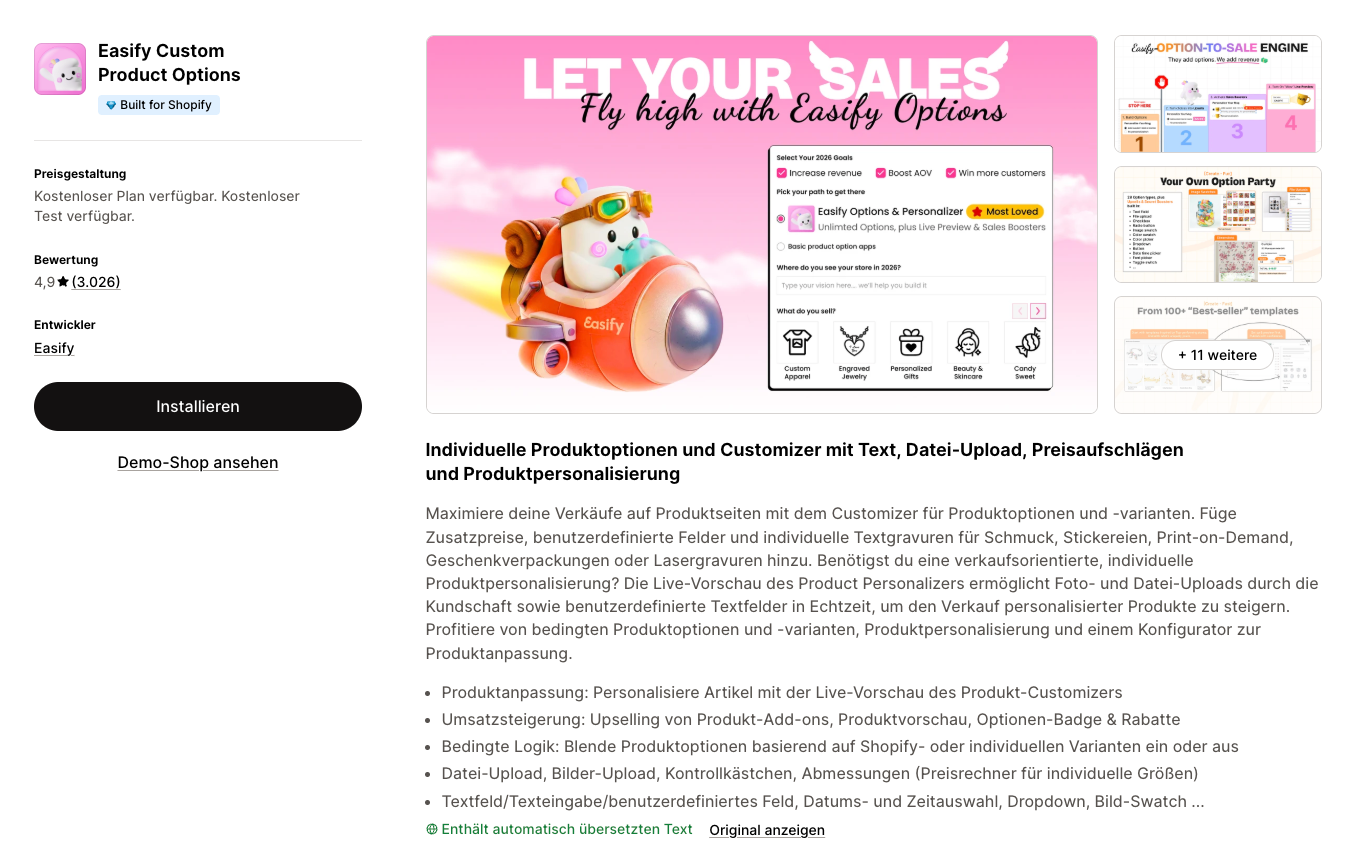
Easify Custom Product Options stands out as an all-in-one solution for merchants who need more flexibility than Shopify’s standard product variants can provide. The app supports 30+ product option types, including text fields, text areas, dropdowns, checkboxes, radio buttons, date and time pickers, color swatches, image swatches, and file uploads.
These options can be added directly to product pages without creating a separate Shopify variant for every possible combination. This makes it easier to offer multiple customization choices while keeping the underlying product catalog manageable.
For stores with more advanced customization requirements, Easify goes beyond basic product options with Product Personalizer, Live Preview, Conditional Logic, Price Add-ons, and custom size and price calculators.
Merchants can also use reusable Option Sets and pre-built templates to speed up setup across multiple products. This combination makes Easify particularly versatile for stores that need to support everything from simple custom text fields to highly personalized products with visual previews and complex configuration rules.
For merchants interested in the broader benefits of personalized shopping experiences, Product Customization: 5 Powerful Reasons It Boosts Shopify Sales provides more context on how customization can support the customer journey.
Pros
- 30+ product option types cover a wide range of customization needs.
- Product Personalizer and Live Preview allow customers to see personalization changes in real time.
- Conditional Logic helps display relevant options based on customer selections, keeping complex product pages easier to navigate.
- File uploads, image swatches, color swatches, and Price Add-ons support a variety of personalized and made-to-order products.
- Reusable Option Sets and pre-built templates make it easier to apply consistent customization setups across multiple products.
- Supports advanced use cases such as custom pricing, measurements, personalization, and product configuration.
- No-code setup and live chat support make the app accessible to merchants without technical expertise.
Cons
- The wide range of features may require some initial configuration for more advanced personalization setups.
- Merchants selling very simple products with only one or two basic options may not need the full feature set.
Pricing
Easify offers a Free Forever plan for merchants who want to get started without a monthly subscription. Paid plans start at $9.99/month, with the Premium plan at $19.99/month and Enterprise at $99.99/month.
Best For
Easify is particularly well suited to merchants selling personalized gifts, apparel, jewelry, print-on-demand products, made-to-order items, and other customizable products. It is also a strong option for stores that expect their customization needs to grow over time and want product options, personalization, Live Preview, Conditional Logic, and pricing tools within a single app.
2. YMQ Product Options, Variants
Key Features
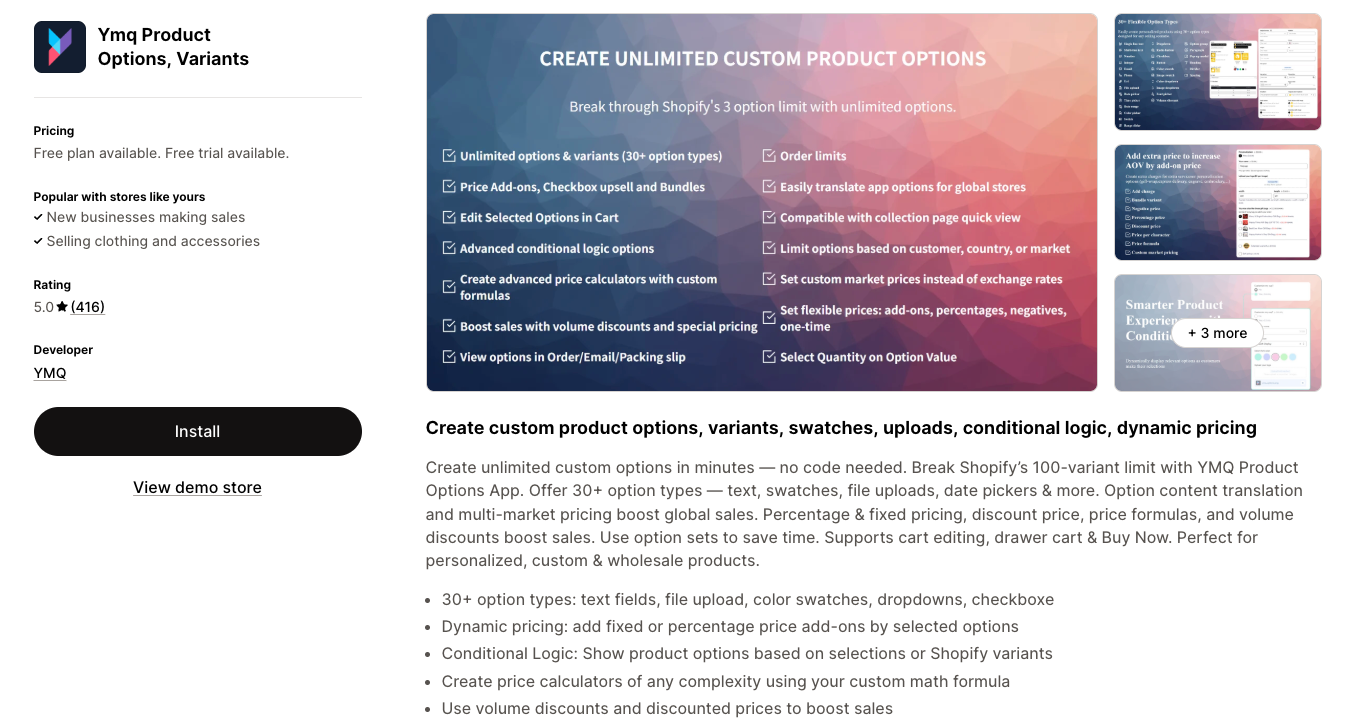
YMQ Product Options, Variants focuses on flexible product options and advanced pricing. It supports unlimited options, multiple field types, Conditional Logic, swatches, and file uploads.
It also offers custom price formulas, quantity discounts, and bulk option management, making it useful for stores where product prices depend on measurements, quantities, or other customer selections.
Pros
- Unlimited product options.
- Advanced pricing formulas and quantity discounts.
- Conditional Logic for complex option setups.
- Bulk management for larger product catalogs.
Cons
- Advanced configurations can take more time to set up.
- May be more functionality than smaller stores need.
Pricing
Free plan available. Paid plans start at $9.99/month, with Advanced at $16.99/month and Plus at $26.99/month.
Best For
Stores that need advanced product options, pricing formulas, Conditional Logic, and quantity-based pricing.
3. W3 Custom Product Options
Key Features
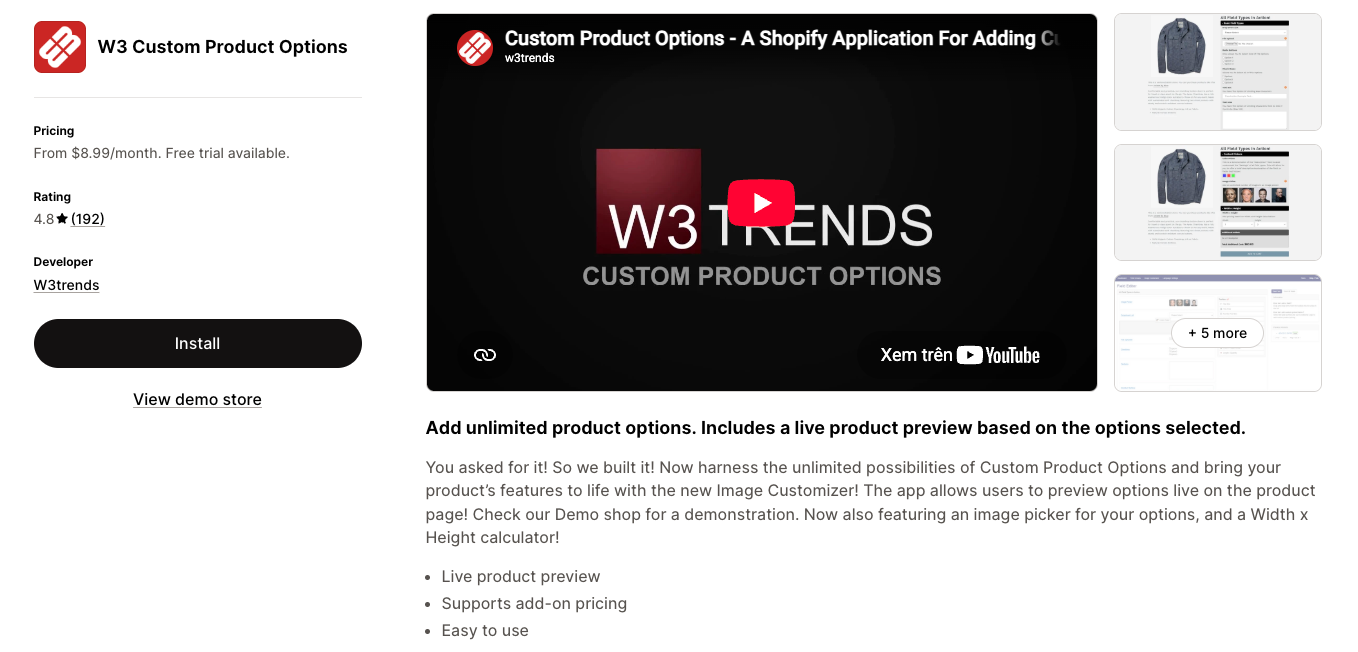
W3 Custom Product Options provides a straightforward way to add unlimited custom product options beyond Shopify’s standard variants. It supports additional option pricing and advanced customization settings.
One of its main advantages is Live Product Preview, allowing customers to see how their selections affect the product before purchasing.
Pros
- Unlimited product options.
- Live Product Preview.
- Supports additional option pricing.
- Simple approach to product customization.
Cons
- Fewer advanced personalization features.
- May not be ideal for highly complex product configurations.
Pricing
Classic plan: $8.99/month. Pro plan: $18.99/month. A 7-day free trial is available.
Best For
Merchants looking for simple product customization with Live Product Preview.
4. SC Product Options
Key Features
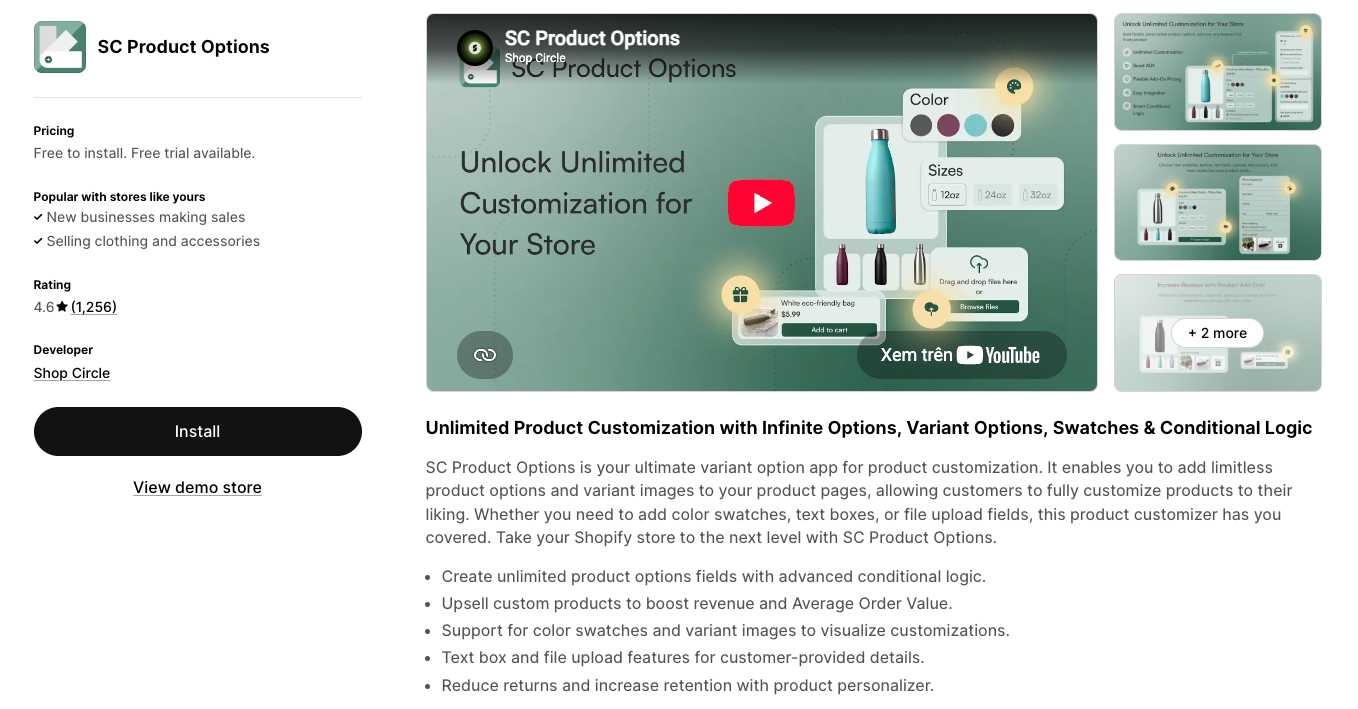
SC Product Options allows merchants to add unlimited product options, including text fields, swatches, file uploads, and other custom fields. It also supports Conditional Logic for displaying options based on customer selections.
The app works with tools such as EComposer and PageFly, making it useful for stores with customized storefronts.
Pros
- Unlimited product options.
- File uploads and visual swatches.
- Conditional Logic.
- Works with popular page-building tools.
Cons
- Advanced features require higher-tier plans.
- Can be more than a simple store needs.
Pricing
Free to install. Basic starts at $14.99/month, while Premium is $39.99/month.
Best For
Stores that need flexible product options, file uploads, swatches, and Conditional Logic.
5. LPO Live Product Options
Key Features
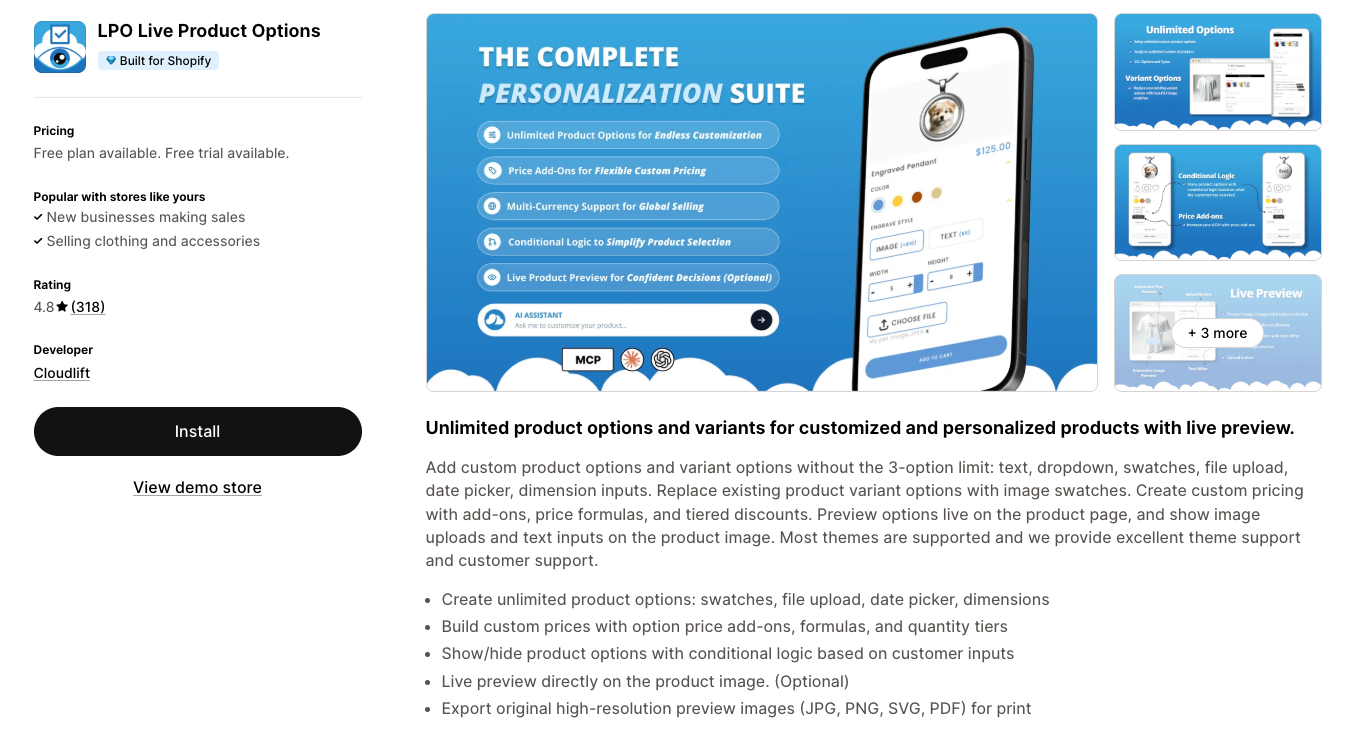
LPO Live Product Options focuses heavily on visual customization. It supports unlimited product options, file uploads, swatches, date pickers, price add-ons, formulas, dimensions, and quantity tiers.
Its Live Product Preview displays customer selections directly on the product image, while high-resolution exports are available in JPG, PNG, SVG, and PDF formats.
Because the quality and presentation of the product image can directly affect how useful a live preview feels, merchants may also want to review Shopify Product Image Size: The Complete 2026 Guide for Perfect Images when preparing product visuals.
Pros
- Strong Live Product Preview.
- Supports formulas and dimension-based pricing.
- File uploads and swatches.
- High-resolution export options.
Cons
- Advanced features may be unnecessary for simple products.
- More complex setups require additional configuration.
Pricing
Free plan available. Starter starts at $9/month, Basic at $19/month, and Pro at $29/month.
Best For
Merchants selling visually customizable products and products with measurement-based pricing.
6. DPO Dynamic Product Options
Key Features
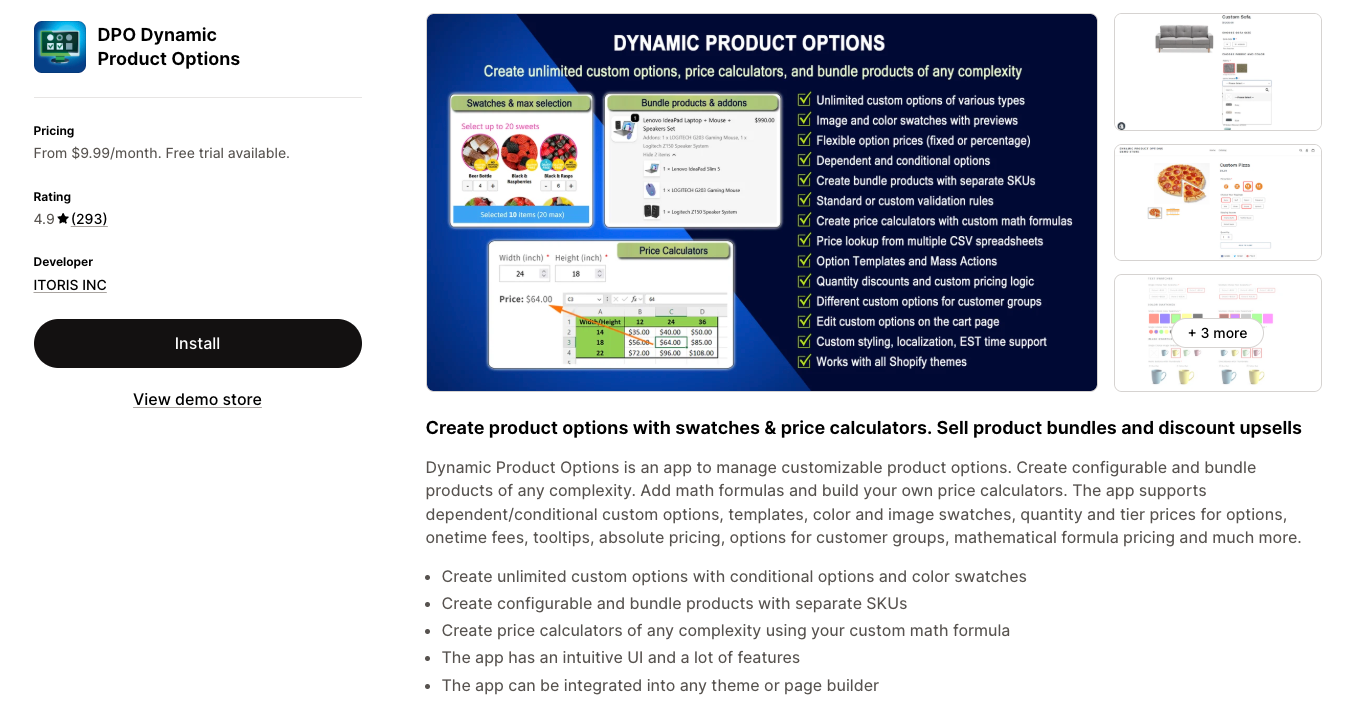
DPO Dynamic Product Options is built around advanced product configuration and dynamic pricing. Merchants can create custom options, Conditional Logic, bundles, and pricing rules based on customer inputs.
Its price calculators and custom formulas are particularly useful for products where the final price depends on dimensions, quantities, or other variables.
Pros
- Powerful price calculators.
- Dynamic pricing and custom formulas.
- Conditional Logic.
- Suitable for complex product configurations and bundles.
Cons
- Advanced pricing setups can take time to configure.
- May be excessive for stores with simple products.
Pricing
Starter starts at $9.99/month, Standard at $19/month, Premium at $29/month, and Ultimate at $49/month.
Best For
Merchants selling made-to-measure products, products with dynamic pricing, and complex configurations.
7. APO Product Options, Variants
Key Features
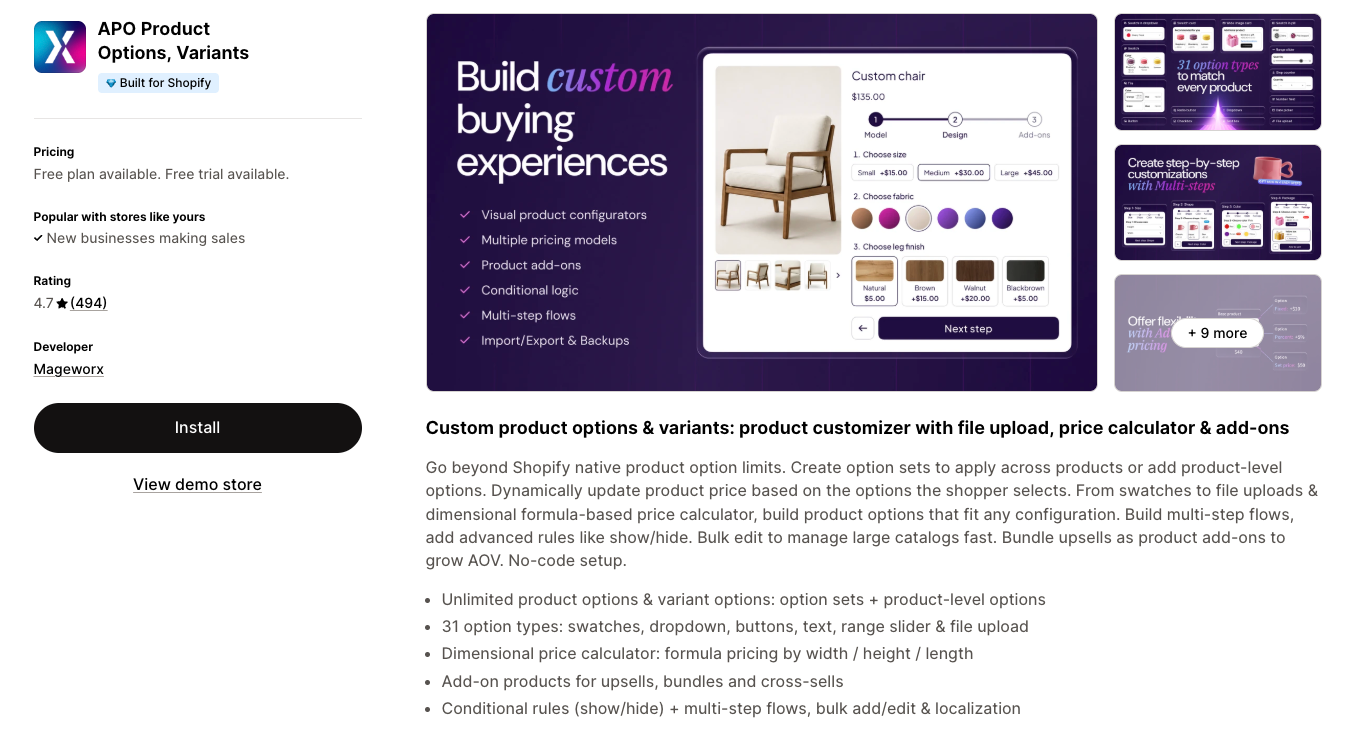
APO Product Options, Variants allows merchants to create unlimited product options, file uploads, swatches, add-ons, and Conditional Logic. It also supports dimension-based price calculators for products where pricing depends on measurements.
For more complex products, APO offers multi-step forms, allowing merchants to divide customization into several stages instead of presenting every option on one page.
Pros
- Unlimited product options.
- Dimension-based price calculators.
- File uploads and add-ons.
- Conditional Logic and multi-step forms.
- Suitable for complex product configurations.
Cons
- Advanced setups can require more configuration.
- Higher plans may not be necessary for smaller stores.
Pricing
Development stores are free. Paid plans start at $14.99/month, with Growth at $29.99/month and Scale at $59.99/month.
Best For
Stores that need advanced product configuration, pricing calculators, file uploads, and multi-step customization.
Final Thoughts
Shopify product customization apps give merchants more flexibility when standard product variants aren’t enough. They can help turn a basic product page into an experience where customers can select additional options, personalize products, upload files, or configure products based on their individual needs.
The right solution depends on the complexity of your products and the experience you want to create. Some stores may only need a few custom fields, while others require Live Preview, dynamic pricing, Conditional Logic, or advanced product personalization.
Before choosing an app, focus on the features your customers actually need and make sure the solution can continue supporting your store as your product catalog and customization requirements grow.
A well-designed customization experience can also make the path from product selection to checkout clearer and easier for customers. For more ways to improve this journey, see Fixing the Drop-off: Improving Your Shopify Conversion Rate from Product Page to Cart.