
Google SGE is now generating AI answers directly in search results, and Shopify merchants are feeling it in their traffic numbers. This guide explains what SGE is, which pages are getting hit hardest, what Google actually looks for when choosing sources, and the three fixes that make the biggest difference fast.
Summary
- Section 1: What Google SGE Is and Why It Matters: Defines SGE as an AI answer block above organic results – and explains its immediate impact on informational and category search traffic.
- Section 2: Which Shopify Pages Are Losing Traffic: Explains why generic content loses out – noting that informational and comparison queries are dropping, while brand and product-specific searches remain stable.
- Section 3: What Google SGE Looks for in Sources: Details the key signals AI needs to cite your page – specifically factual content, E-E-A-T signals (like reviews), and structured data.
- Section 4: Three Fixes That Make the Biggest Difference: Actionable steps to take – rewriting product descriptions with concrete details, adding AI-friendly FAQs, and fixing structured data/duplicate content.
- Section 5: How to Track Progress and What to Do Next: Covers how to measure success with Google Search Console – along with realistic timelines and how SearchPie handles the technical optimization.
What Is Google SGE and Why Should Shopify Merchants Care
SGE stands for Search Generative Experience. In the US, Google now calls it AI Overviews. Whatever the name, the effect is the same: when someone searches Google, an AI-generated answer now appears at the top of the page, above all the regular results.
Google’s AI pulls information from several websites, summarizes it into one block, and the searcher reads the answer right there. No click needed. No visit to your store.
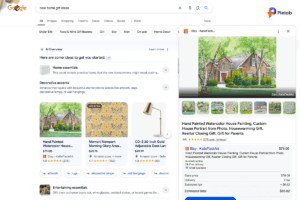
This is what Google SGE looks like for a typical product query. Someone searches for “best yoga mat for hot yoga under $40.” Google generates a paragraph recommending what to look for, names a few features, and cites two or three sources. Most searchers read it and move on. The stores that used to get those clicks no longer do.
For Shopify merchants, this creates a real problem if your store relies on informational or category-level search traffic. It creates an opportunity if your content is specific and credible enough to be one of the sources Google cites.
Which Shopify Pages Are Getting Hit Hardest
Not all traffic is affected equally. The pattern that shows up across Shopify stores looks like this:
Merchants in the Shopify community have confirmed this pattern. One thread noted that click-through from Google has been falling even when rankings stay the same, and informational queries are getting hit hardest. Product-specific and brand queries are holding up because the searcher already knows what they want.
The stores struggling most have one thing in common: generic content. Descriptions that could apply to any product in the category. Pages that exist to capture keyword traffic but offer nothing a buyer genuinely needs to read. Google SGE has no reason to cite those pages, and neither does any other AI tool.
What Google SGE Actually Looks For in a Source
Google SGE does not pick sources randomly. When it pulls from a page to build an AI answer, it is looking for three things most Shopify product pages do not have.
Specific, factual content. “Premium quality, great for gifting” tells Google nothing. “This 20oz stainless steel mug keeps drinks hot for 8 hours, fits standard car cup holders, and is dishwasher safe” gives Google something concrete to work with. Specificity is the easiest fix and it also improves conversion rate at the same time. Google SGE does not pick sources randomly. When it pulls from a page to build an AI answer, it is looking for three things most Shopify product pages do not have.
According to Google Search Central, content should be helpful, reliable, and people-first. This principle directly shapes how SGE selects and summarizes sources.
E-E-A-T signals. E-E-A-T stands for Experience, Expertise, Authoritativeness, and Trustworthiness. For a Shopify store, this shows up in real customer reviews, accurate product specs, clear return policies, and content that reflects actual knowledge of the product. A page with two sentences of generic copy and no reviews sends the opposite signal.
Structured data. Schema markup tells Google explicitly what is on your page: product name, price, availability, reviews, FAQ answers. When this is in place, AI systems can extract and use your information far more easily. Most Shopify themes include basic product schema, but review schema and FAQ schema are almost always missing, and those are exactly what helps SGE visibility most.
Three Fixes That Make the Biggest Difference
Fix 1: Rewrite Your Top Product Descriptions
Go to your top 20 product pages sorted by impressions in Google Search Console. For each one, replace any vague copy with concrete details: dimensions, materials, compatibility, specific use cases, honest notes about what it is not good for.
This takes 20 to 30 minutes per page. It is the highest-return work you can do right now for both SGE visibility and conversion rate.
Fix 2: Add a FAQ Section to Key Pages
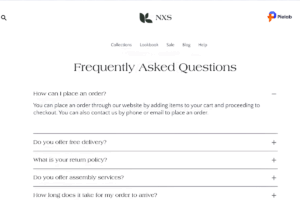
FAQ content is directly useful for Google SGE. When AI is generating an answer to a question-based search, it pulls from FAQ sections because the content is already structured as a question and answer.
Add 3 to 5 real buyer questions to each important product page. “What size should I order?” “Is this compatible with X?” “How long does shipping take?” Write the answers in one or two clear sentences. You can add these in the Shopify page editor without any code changes.
Fix 3: Check and Fix Your Structured Data
Go to Google’s Rich Results Test and paste in your product page URL. If it is not showing product schema with price, availability, and reviews, that is a gap worth fixing.
In Google Search Console, open the Pages report under Indexing and look for “Duplicate, submitted URL not selected as canonical” warnings. Shopify creates multiple URLs for the same product when it appears in different collections, and without canonical tags in place, ranking signals get split across duplicates instead of concentrated on one page.
Both of these issues, missing schema and duplicate content, can be managed through a Shopify SEO app without touching theme code.
How to Know If Your Changes Are Working
After making changes, check Google Search Console every two weeks. Look at the Performance report filtered by the pages you updated.
Give it 8 to 12 weeks before drawing conclusions. SGE-related changes take longer to show up in data than a standard title tag update.
Ready to Make Your Shopify Store Visible to AI Search?
Understanding what Google SGE needs is one thing. Implementing structured data, fixing canonical tags, and auditing schema across hundreds of product pages is where most merchants get stuck.
SearchPie’s Optimize for AI feature handles the technical side for you. It audits your schema markup, identifies pages missing structured data, flags duplicate content issues, and pushes fixes across your store without any code changes.
If structured data and canonical tags have been on your to-do list for months, SearchPie is the shortcut. Run your first AI readiness audit in under 5 minutes.
Install SearchPie on the Shopify App Store and see exactly which pages Google SGE cannot read yet.
FAQs
Search Generative Experience (SGE) is an experimental, AI-powered search feature from Google that generates direct summaries for user queries, rather than just displaying a list of website links. It is designed to act as a “chatbot” within search, providing quick answers, summarizing complex topics, and allowing users to ask follow-up questions in a conversational mode.
Search Generative Experience (SGE) by Google is an experimental AI search feature that delivers concise, conversational summaries at the top of results, using generative AI to combine information from multiple sources, often reducing the need to visit individual websites.
Search Generative Experience (SGE) is Google’s AI-powered search approach that generates synthesized answers and summaries at the top of search results, rather than just listing links. SGE aims to enhance user experience by directly answering complex queries.
Optimizing for Google SGE (now often termed AI Overviews) requires creating concise, authoritative, and conversational content that directly answers user queries, often in a Q&A or list format. Focus on E-E-A-T (Experience, Expertise, Authoritativeness, Trustworthiness), use structured data (schema markup), and build topical authority through internal linking to ensure your content is chosen for AI-generated summaries.
Ranking on Google SGE (AI Overviews) requires creating concise, authoritative, and structured content that directly answers user queries, often by targeting “position zero” in traditional search. Focus on long-tail conversational keywords, use Schema markup, build high topical authority, and ensure fast page speeds to increase the likelihood of being cited by the AI.
Not if you adapt. Informational queries have been hit hardest, but product-specific and brand queries are holding up. Stores with specific, credible content have a path forward. Thin, generic pages are the ones losing ground.